Categoría: Exterior Doors

  • Sliding Patio Door Hard to Open? Find What’s Causing the Drag

    Sliding Patio Door Hard to Open? Find What’s Causing the Drag

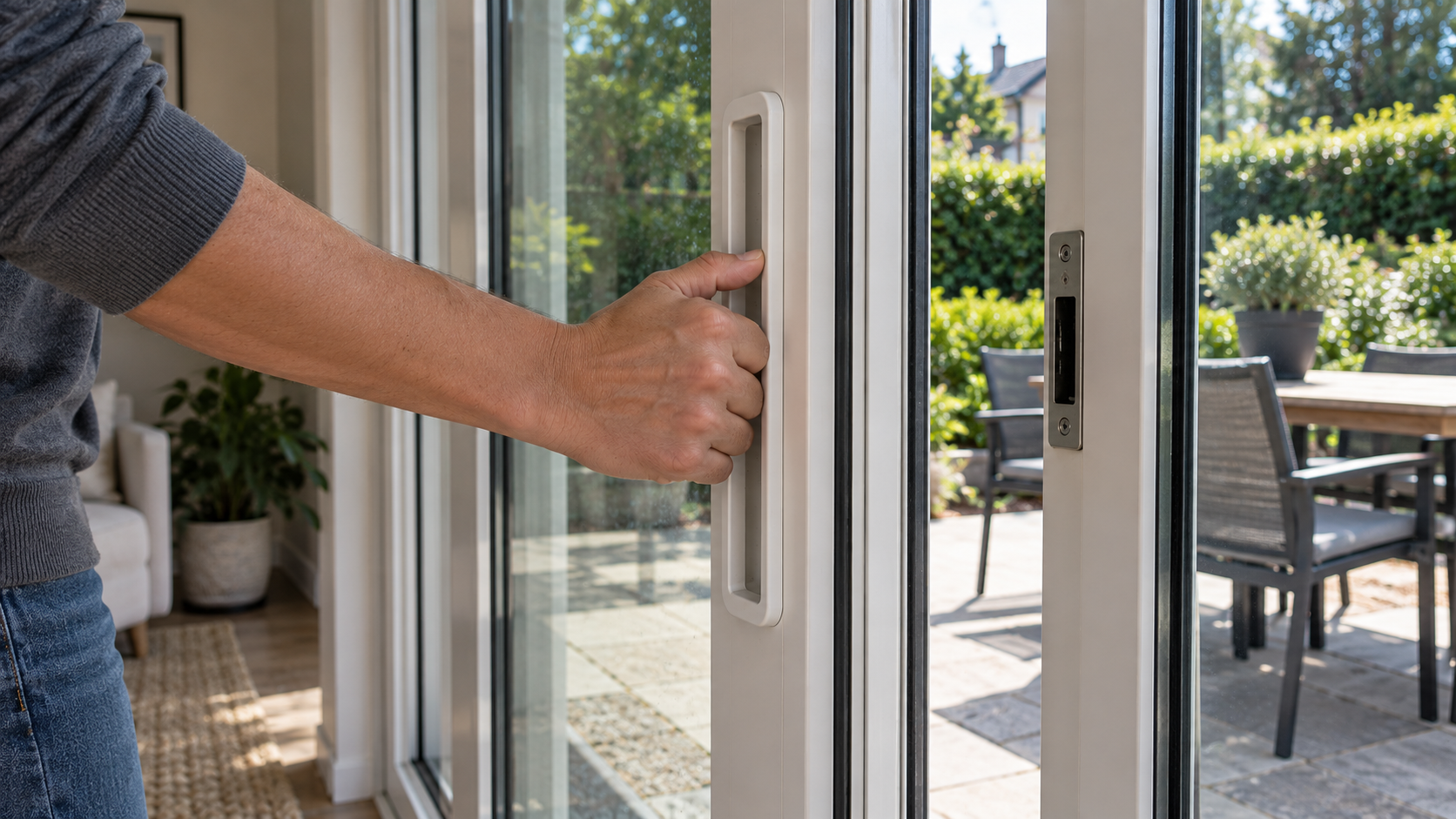
    If your sliding patio door has become hard to open, don’t start by spraying lubricant on the track or replacing the rollers. First, pay attention to how the resistance feels and where it happens.

    A door that’s difficult to move along its entire track points you in a different direction than one that catches at exactly the same spot every time. A door that scrapes along the bottom gives you different evidence than one that rolls smoothly until the final few inches.

    Start here: Slide the door slowly through its full travel once. Don’t force it. Notice whether the resistance is constant, happens in one specific spot, or comes with scraping or grinding.

    Where Is the Door Hard to Move?

    It’s hard to move through most or all of its travel. Start with the accessible track and the way the panel is sitting in the frame — debris can interfere with movement, and a panel that isn’t sitting correctly can drag instead of moving freely. Continue to the track check below.

    It moves normally except at one specific spot. Pay close attention to that exact location. Look for packed debris, a small object in the track, visible damage or deformation, a raised or damaged section of track, or a point where the panel appears to make contact. A problem that repeats at the same spot is useful evidence — inspect that location before adjusting the whole door.

    It becomes difficult only near the fully closed position. Don’t assume the rollers are the problem yet. Watch whether the panel begins contacting the jamb, weatherstripping, or locking area as it approaches closed. If movement itself stays smooth but the door simply won’t lock, that’s a separate diagnostic — the lock and receiver, not the rollers.

    It scrapes or makes a grinding sound. Stop treating this as simple stiffness. The sound and exact location of the contact help narrow down whether the panel is dragging or there’s a specific track/roller issue underneath.

    Is the Bottom Track Visibly Dirty or Obstructed?

    Inspect the accessible track without removing the door.

    Yes. Clean the accessible track first. Vacuum loose debris, then remove what remains with a method appropriate to your door’s care instructions. Operate the door again afterward. If it now moves normally, you’ve found a real contributor — no roller adjustment is needed just because the door was previously difficult to move. If it’s still difficult, continue the diagnosis below.

    No — the accessible track looks reasonably clean. Don’t add lubricant just because the track looks dry. Continue to the panel alignment check below.

    Is the Moving Panel Sitting Square?

    Open the door slightly, leaving a narrow vertical gap between the closing edge of the moving panel and the side jamb. Compare that gap from top to bottom — this is the same check several patio door manufacturers, including Andersen, use to confirm whether a gliding panel needs roller adjustment.

    The gap is noticeably wider at one end. The panel isn’t sitting evenly relative to the jamb, which makes panel/roller adjustment the area to investigate next.

    The gap appears approximately even. The panel may already be reasonably aligned. If the track is clean and the gap is even but the door still moves poorly, the rollers themselves or another mechanical source of resistance deserves closer investigation.

    Most Consistent With

    What you observeFirst area to investigate
    Resistance throughout most of the travel + dirty trackAccessible track / debris
    Resistance throughout most of the travel + uneven panel gapPanel / roller alignment
    Catches at the same spot every timeLocal track obstruction or damage
    Scrapes along the bottomPanel height/alignment or roller system
    Grinding or rough mechanical soundRoller/track system — different diagnostic
    Smooth movement until the last few inchesJamb, weatherstripping, or locking area
    Clean track + even panel gap + continued heavy movementRollers or another mechanical issue
    Bent or damaged track, unstable panelProfessional assessment

    The goal isn’t to name a part as quickly as possible — it’s to determine which part of the system deserves investigation next.

    Why This Fits

    A sliding patio door operates as a system: the moving panel travels through a frame while its rollers and track control its position. If the panel is no longer positioned correctly, it can begin to drag even though nothing is technically broken — several manufacturers’ own troubleshooting guidance treats a stiff, dragging panel as a sign of misalignment first, checked by comparing the panel-to-jamb gap, rather than assuming a roller has failed.

    But that’s only one possible explanation. Resistance can also come from something much simpler — debris in the track — or from a localized mechanical problem that shouldn’t be «fixed» by adjusting the alignment of the entire panel. That’s why where and how the door resists movement matters more than the fact that it resists at all.

    Don’t Do This Yet

    • Don’t lubricate everything. A difficult sliding door doesn’t automatically need lubricant, and some products attract more dirt than they solve. Identify the source of the resistance first.
    • Don’t replace the rollers because the door feels heavy. Poor movement is evidence of a problem, not proof of a failed roller. Check the track and panel alignment before buying parts.
    • Don’t adjust rollers randomly. Adjustment should aim at a clear, measurable target — an even panel-to-jamb gap and smooth operation — not just «until it feels better.»
    • Don’t remove the glass panel as your first diagnostic step. You can learn a great deal from low-risk, reversible observations before handling a large glass panel.
    • Don’t keep forcing the handle. The handle isn’t designed to compensate for a mechanical problem elsewhere in the door. If it takes real force, stop and find the source of resistance instead.

    Fix

    If the track is dirty: vacuum loose debris and clean the running surface as you go, then test the door again before doing anything else. If cleaning changes the door’s behavior, that’s meaningful diagnostic information on its own — don’t automatically move on to lubrication or roller replacement as if every hard-to-open door needs the same repair sequence.

    If the panel is out of alignment: roller adjustment may be appropriate once you’ve confirmed an uneven panel-to-jamb gap. Identify your door’s manufacturer and series first, since adjustment mechanisms vary — for gliding doors from manufacturers like Andersen, the general procedure is to make small incremental roller adjustments, check the door’s operation after each one, and verify the gap becomes even rather than adjusting until the door merely feels better. After changing panel alignment, recheck the lock as well — roller adjustment can change how the panel meets the latch receiver.

    If it catches at one specific spot: inspect that exact section of track for debris, a raised area, a dent, deformation, or damage to the running surface. Don’t change the entire panel’s alignment just because one location causes trouble — a localized symptom deserves a localized inspection first. If the track itself is visibly bent or damaged, stop before attempting to reshape structural door components without the correct procedure.

    If the track is clean and the panel looks square but the door is still difficult to move: you’ve ruled out the two easiest explanations, and the roller system itself becomes more relevant. That doesn’t prove the rollers need replacing — the next step is identifying your specific door system and what its manufacturer recommends for roller inspection.

    Stop Conditions

    Stop DIY work and consider professional help if:

    • The glass is cracked or damaged.
    • The panel appears loose, unstable, or partially off its track.
    • The track or frame is visibly deformed.
    • Moving the door requires substantial force.
    • Proper inspection would require removing a large glass panel and you’re not equipped to handle it safely.
    • The adjustment mechanism itself is damaged or inaccessible.
    • The door remains severely difficult to operate even after basic track and alignment checks.

    The purpose of troubleshooting is to reduce unnecessary work, not to escalate a manageable problem into a risky repair.

    What You May Need

    • Flashlight
    • Vacuum with a crevice attachment
    • Soft or non-metallic cleaning brush
    • Clean cloth
    • Screwdriver appropriate to your door’s adjustment hardware
    • Your door’s manufacturer and model/series information, before ordering any part

    Repair, Replace, or Wait?

    • Clean or adjust: the first path when the evidence points to accessible debris or a correctable panel alignment.
    • Repair or replace a component: appropriate once you’ve identified actual damage or a mechanical part that no longer operates correctly.
    • Replace the entire door: a separate evaluation, not the default response to poor sliding — consider the whole system’s condition and repairability first.
    • Wait: a mildly stiff door may not be an emergency, but don’t ignore a problem that’s getting rapidly worse, shows visible damage, or requires increasing force. Continued forcing can turn a diagnostic problem into actual damage.

    Still Not Solved?

    • Door scrapes or makes a grinding sound → Sliding Patio Door Grinding
    • Door moves but won’t lock correctly → Sliding Patio Door Won’t Lock
    • Track appears damaged → Sliding Patio Door Track Damage
  • Sliding Patio Door Won’t Lock? Here’s Why (2026)

    Sliding Patio Door Won’t Lock? Here’s Why (2026)

    META DESCRIPTION: Your sliding patio door won’t lock or latch? Learn the real causes — from panel alignment to a failed lock mechanism — and what to check first.

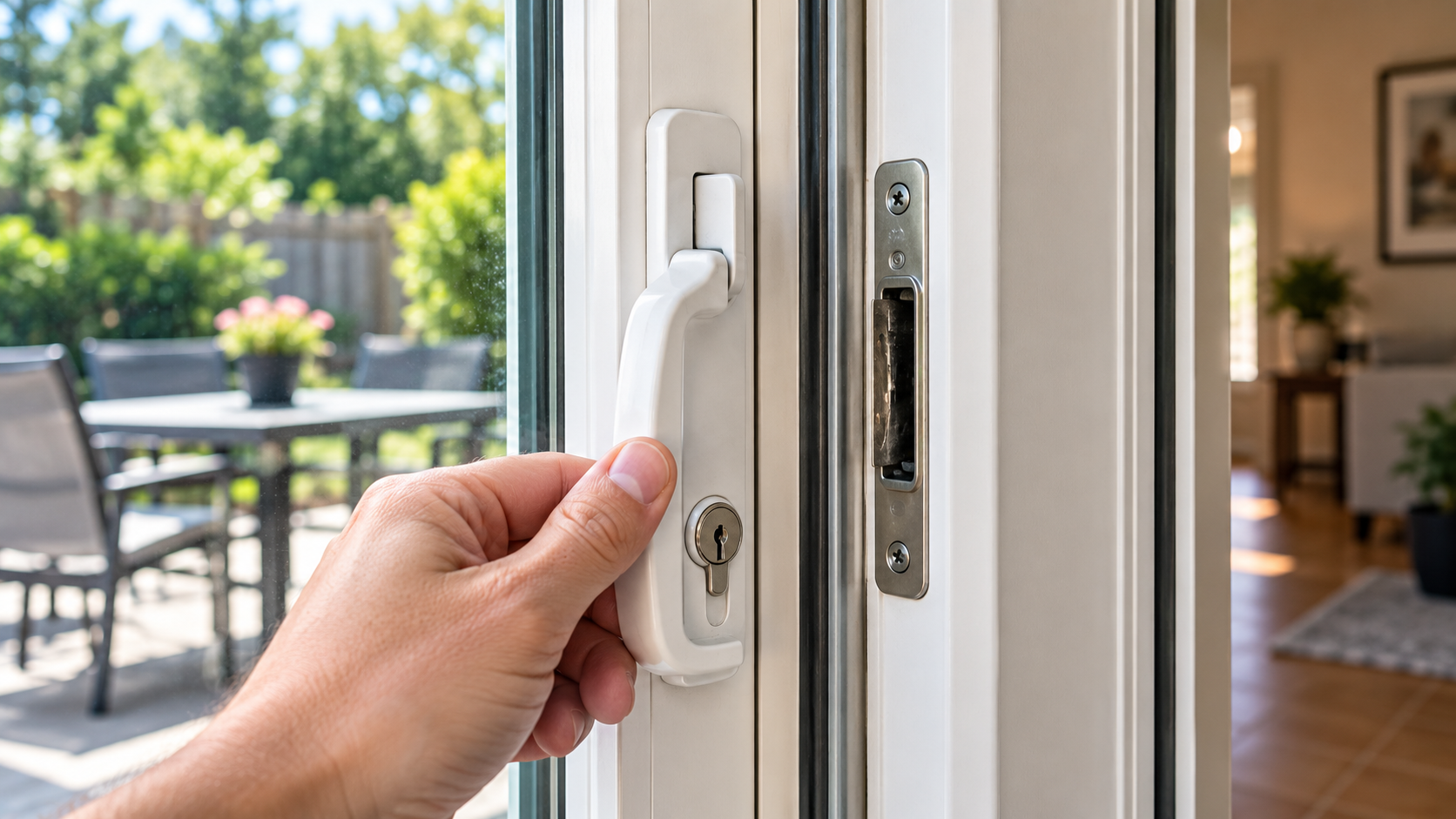
    If your sliding patio door won’t lock, don’t replace the lock yet. Most of the time, this isn’t a broken lock — it’s one of three different things happening, and they can feel identical from the handle:

    • The door isn’t reaching the fully closed position.
    • The door closes, but the latch and receiver don’t line up.
    • The door closes and aligns, but the locking mechanism itself doesn’t work.

    30-second check: Open the door and operate the lock. If the mechanism moves normally while the door is open but won’t engage when the door is closed, alignment is the first thing to investigate — not the lock itself.

    Does the Door Close All the Way?

    Close the door slowly, without forcing it.

    Yes — it reaches the jamb normally, but won’t lock. Good. You’ve separated the locking problem from a door that simply can’t close. Next, check whether the lock mechanism works with the door open (see below).

    No — it stops short, catches, or becomes difficult to move. Don’t troubleshoot the lock yet. If the panel can’t reach its correct closed position, the latch can’t meet its receiver correctly, no matter what you adjust on the lock. Inspect the accessible lower track for dirt or packed debris, small objects, visible track damage, or a specific point where the panel suddenly catches. If the door feels rough or heavy throughout its full travel, the roller and track system — not the lock — is where to focus next.

    Does the Lock Work With the Door Open?

    With the door open, operate the thumb latch or locking control gently.

    Yes — the lock moves normally. That makes a fully failed locking mechanism less likely. The next question is whether the latch and receiver actually meet in the right position when the door closes.

    No — it’s stiff, jammed, or doesn’t move through its normal range. The evidence now points more toward the locking hardware itself. Don’t repeatedly force it — check for visible damage, corrosion, loose hardware, or a hook/bolt that doesn’t extend and retract normally.

    Watch What Happens at the Latch

    Close the door slowly while watching where the moving latch or hook approaches the fixed receiver on the frame.

    • The latch passes above or below the receiver: this points to a vertical alignment problem. Before moving the receiver, check whether the panel itself is sitting square (see below).
    • The latch reaches the right height but doesn’t engage cleanly: the panel may be aligned while the receiver or locking hardware needs its own adjustment.
    • The latch never reaches the receiver at all: something is preventing the panel from reaching its correct closed position — go back to the track/roller check above.
    • You can’t tell where it’s missing: stop the door about an inch from the jamb and compare the gap between the panel and the jamb at the top versus the bottom. An even gap suggests the panel is reasonably square. A gap that’s noticeably wider at one end points to panel/roller alignment before you touch the lock receiver.

    Most Consistent With

    What you observedFirst area to investigate
    Door won’t reach the jambTrack, obstruction, or roller/panel movement
    Door closes; latch misses high or lowPanel/roller alignment
    Panel gap is visibly uneven top to bottomPanel/roller alignment
    Panel appears square; latch still missesReceiver/lock adjustment
    Lock is stiff even with the door openLocking mechanism itself
    Several locking points don’t engageMulti-point alignment or hardware
    Track or frame is visibly damagedMechanical damage — professional assessment

    A door that won’t lock doesn’t automatically have a broken lock. The symptom tells you where to start looking, not which part to buy.

    Why This Fits

    A sliding patio door doesn’t lock in isolation. The track and rollers determine where the moving panel actually sits, and the locking hardware then has to meet a receiver mounted separately on the stationary frame. Sliding panels carry real weight — often 150 to 400+ pounds for a modern insulated glass unit — on a small set of rollers, and as those rollers wear unevenly over years of use, the panel’s position shifts by a small amount. Because the latch and receiver are built with very little tolerance for that kind of movement, even a small shift is enough for the latch to miss its target while every individual piece of hardware still works correctly. This is also why doors that lock fine in one season and jam in another often haven’t developed a new fault — seasonal expansion and contraction is often just enough to push an already-marginal alignment over the edge.

    Fix the geometry before blaming the hardware. But don’t take that too far: if the lock remains stiff or fails to move normally while the door is open, alignment no longer explains the whole problem, and the lock mechanism itself needs attention.

    Before Adjusting Anything

    Before loosening a single screw, confirm two things: is the panel sitting correctly, and does the lock meet its receiver correctly? Open the door, inspect the lower track, operate the lock with the door open, then close it slowly while watching where the latch approaches the receiver. If you can answer those two questions, you’ve already ruled out several possible causes without replacing anything.

    Don’t Do This Yet

    • Don’t replace the lock just because it doesn’t catch. If the mechanism operates normally with the door open, a new lock will likely leave you with the exact same alignment problem.
    • Don’t move the receiver to compensate for an obviously crooked panel. You may make the latch catch while leaving the underlying panel problem unresolved. Check panel alignment first.
    • Don’t make large roller adjustments by trial and error. The location and direction of adjustment vary by manufacturer and door system — identify your specific door before making a significant change.
    • Don’t force a door that suddenly became difficult to move. A new obstruction or a damaged track deserves inspection before more force is applied.

    Fix

    If the panel is out of alignment: most sliding patio doors have roller adjustments near the bottom of the moving panel, but there isn’t one universal procedure — the direction and location of the adjustment screw varies by manufacturer. Make a small adjustment, move the door through its full travel, recheck the panel-to-jamb gap, and test the lock before adjusting further. The goal isn’t just to make the latch catch — it’s to have the panel sit and travel correctly, so the lock engages on its own.

    If the panel is square but the latch still misses: the receiver is the more likely fix. Before changing its position, mark the current location with a pencil — that gives you a reference point and makes the adjustment easy to reverse if it doesn’t help. Loosen the mounting screws, shift the receiver to meet the latch, and retighten. Avoid repeatedly nudging it around by trial and error; you want to understand which component was actually out of position, not just land on a lucky adjustment.

    If the door is hard to slide: treat this as a movement problem before a locking problem. Vacuum the track and clean it with a stiff nylon brush, focusing on the corners where debris accumulates. If the panel still moves poorly after cleaning, the roller and track system needs a closer look before the lock does.

    If the lock is stiff with the door open: this points more directly to the locking hardware itself. Look for visible damage, corrosion, loose hardware, or a hook/bolt that doesn’t travel normally. Before ordering a replacement, note the manufacturer, door series if available, faceplate dimensions, and screw spacing — sliding patio door lock components are not universally interchangeable, and a part that looks similar in a photo may not fit.

    If it’s a multi-point lock and only some hooks engage: don’t treat this like a simple single-latch adjustment. First confirm the panel itself is aligned, then identify the exact locking system before adjusting individual receivers. Moving several receivers independently without understanding the system can create a new alignment problem while trying to fix the first one.

    Stop Conditions

    Stop DIY troubleshooting and consider a professional assessment if:

    • The track or frame is visibly bent or damaged.
    • The glass itself is damaged.
    • The panel appears unstable or partially off its track.
    • The door requires substantial force to move at all.
    • Fixing it would require removing or re-seating the panel — these panels are heavy, and this is realistically a two-person job at minimum.
    • Several points of a multi-point system remain misaligned after checking the panel itself.

    A large sliding glass panel is not the place to turn a simple diagnostic into an unnecessary handling risk.

    What You May Need

    • Flashlight
    • Screwdriver appropriate to your hardware
    • Pencil, for marking the receiver’s original position before adjusting it
    • Vacuum with a crevice attachment
    • Stiff, non-metallic brush
    • Your door’s manufacturer and model information, before ordering any replacement part
    • Lubricant appropriate to your specific door — check your manufacturer’s care instructions rather than assuming one product suits every roller, track, or lock system

    Repair, Replace, or Wait?

    • Adjust or repair: the right first move when the panel is slightly misaligned, the receiver needs adjustment, the track needs cleaning, or the existing hardware is functional and adjustable.
    • Replace a component: reasonable once you’ve confirmed actual mechanical damage or failure in the lock, rollers, or another specific part — replace the part that’s actually failed, not whatever happens to be closest to the symptom.
    • Replace the entire door: a door that won’t lock is not, by itself, a reason to replace the whole unit. That’s a separate decision that should weigh the condition of the frame, track, rollers, glass, seals, and hardware as a whole.
    • Wait: not recommended if this door is part of your home’s security. If a permanent fix can’t happen right away, use an appropriate temporary secondary lock or brace until it’s resolved.

    Still Not Solved?

    Where to go next depends on what you observed:

    • Door stops short or is difficult to move → Sliding Patio Door Hard to Open
    • Door scrapes or makes a grinding sound → Sliding Patio Door Grinding
    • Panel appears correctly aligned but the lock still won’t engage → Sliding Patio Door Lock & Receiver Diagnostic
    • Lock hardware itself is visibly damaged → How to Identify a Sliding Patio Door Lock
  • Hello world!

    Welcome to WordPress. This is your first post. Edit or delete it, then start writing!